THE BLACK RITUAL THEATRE
An Interview with Robert Macbeth
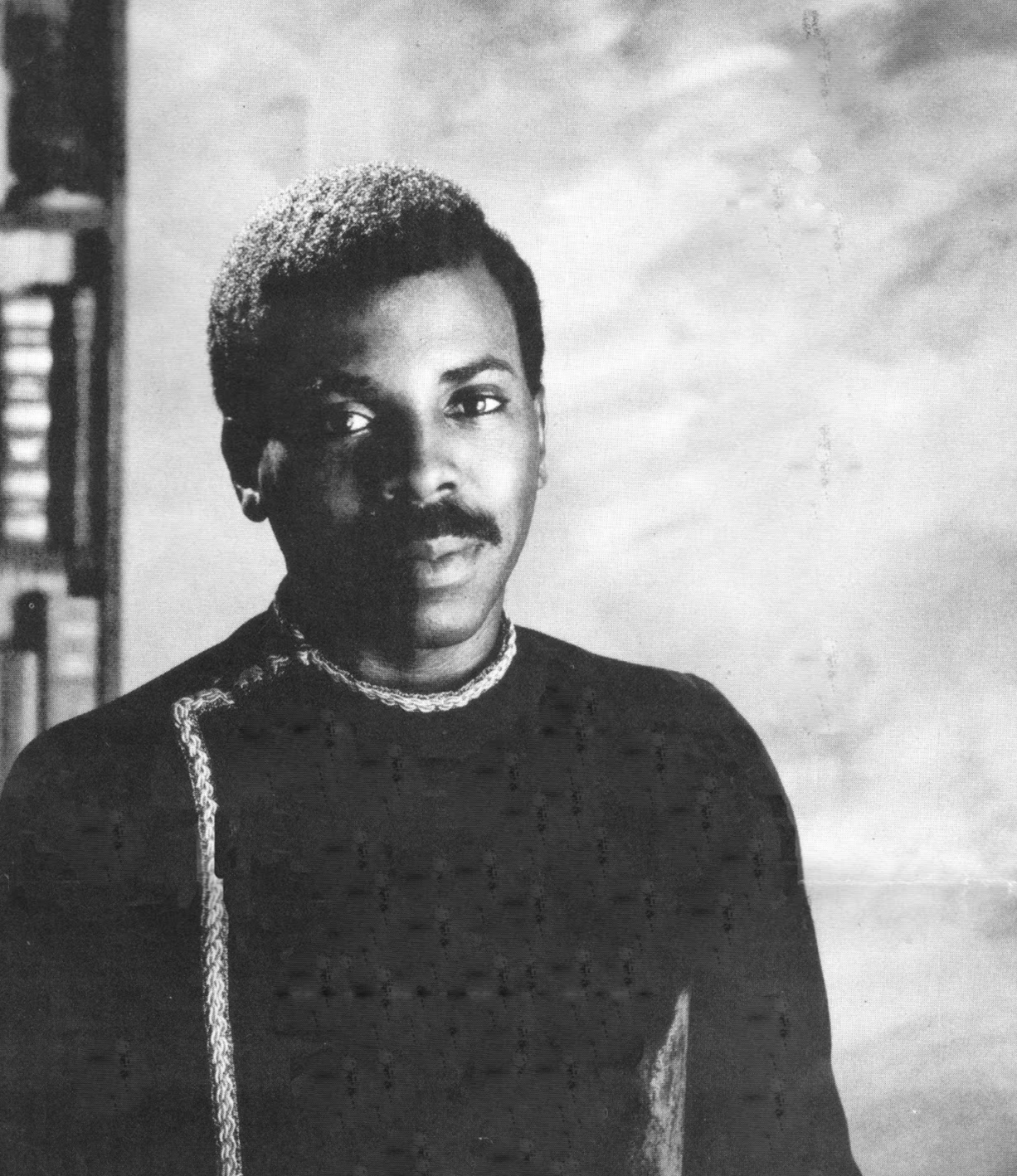
Marvin X, Black Educational Theatre, 1972, San Francisco
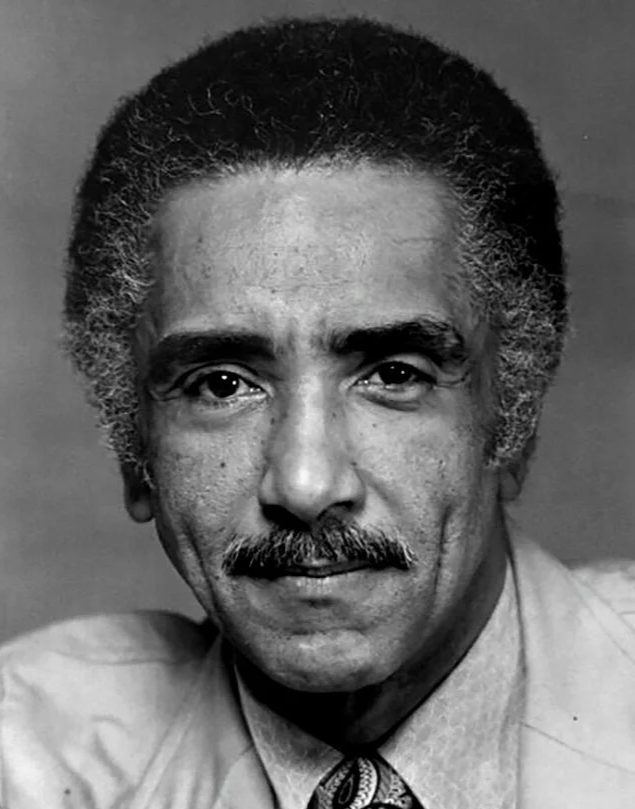
Founder of New Lafayette Theatre Robert Macbeth. Courtesy of The New York Times.
“So we actually won’t be free until we change our language.”
Macbeth:
Perhaps that's where we have arrived. Perhaps we have reached a point where the ritual more naturally fits the tone of what we have to do, because in reality the theatre as we do it is really a white western form-the way we do it at the New Lafayette even.
It's still a white western form.
We use it to suit our purposes, but there will come a point where our purposes will exceed its possibilities and potentials.
So at that point we have to have a new form available to us.
Marvin:
What elements in our theatre represent white western forms?
Macbeth:
The element of a formal play, that is, a story to be told by people acting it out on stage-not acting it out but in conversation on the stage. That's really only partially what it is-what it is I might not be able to describe to you. I know as a director that those elements exist. I know as a director that there are white western elements that I can't help. First of all, because we're here and because we use the English language because of all those kinds of vibrations, even to the point where I couldn't do any other kind of theatre if I wanted to get money from the sources that I get it from to do it. Because if I said I was going to do what might be truly theatre for us as Black people and tell them that, they most certainly wouldn't understand that as anything that they understand as theatre. So the ritual form will be, of course, the form that we will follow, the form the western world calls audience-participation, but there is no audience as far as I'm concerned.
My attitude toward theatre is that there is no audience, and no actors, that the separation is very slim, and that the people who come to "The Room" come to be in the "play," because their being there is part of the play. You wouldn't exist if they weren't there. So that kind of audience-participation is built right into it, because the people can do the rituals also, they participate in them their way, in the same way that the white man's church functions; it gets our people to participate in a pagan ritual, really, a ritual of worship to a white god that has no reality for us as a people, but our people do participation in the ritual-it's too bad. But in the theatre we're going to finally reach the point where the communication between the people who perform the rituals and the people who sit through them-the communication will be much more direct; it will even be physical, he actors will touch the audience and the audience will then come with the actors into the play or into the ritual.
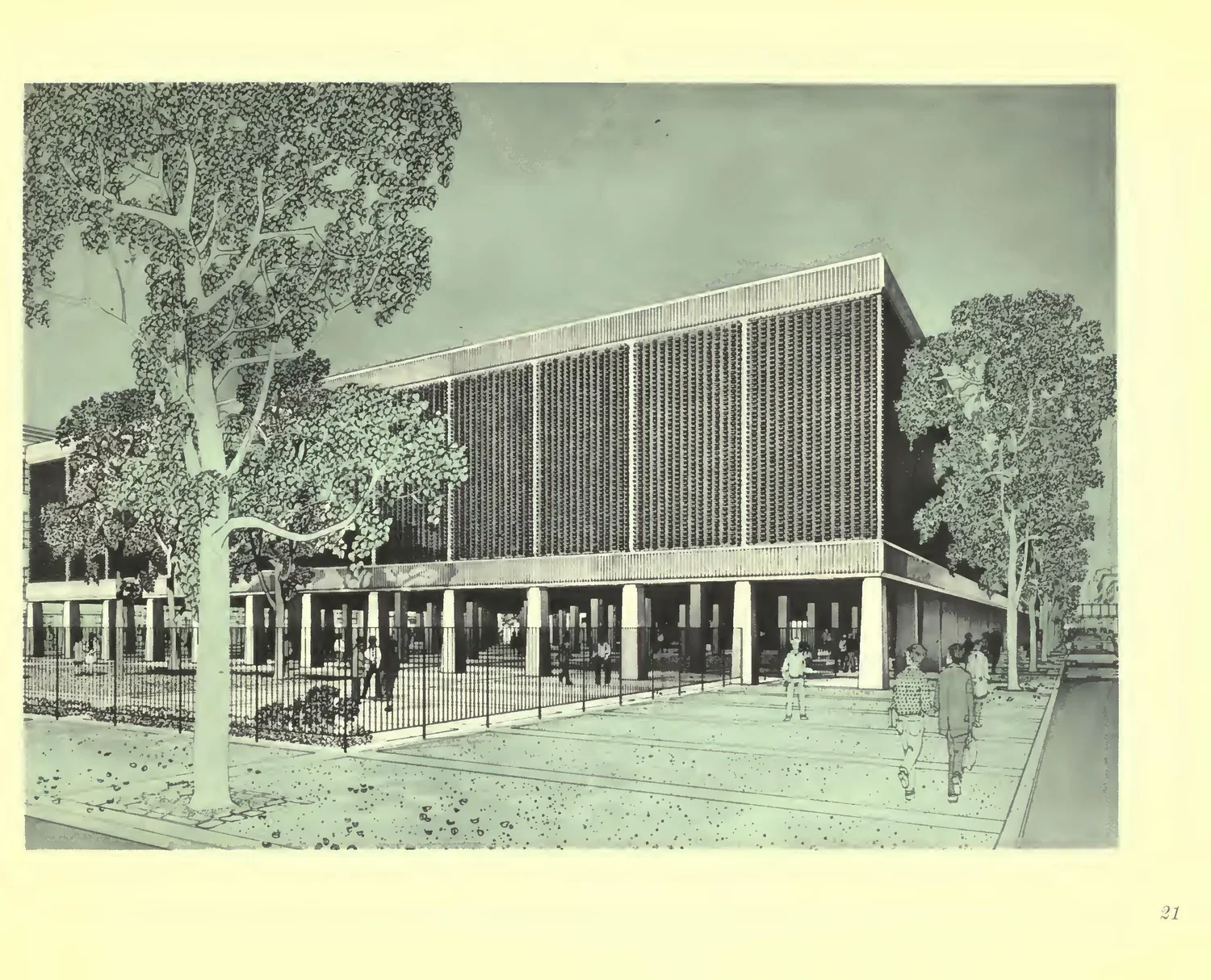
View of IS 201, Curtis and Davis, 1963.
Credit: Office of Civil Defense, Department of Defense, “New Buildings with Fallout Protection” (Washington, D.C., 1963), 20–23. A copy of the drawing is in the National Archives.
That was some of what we did at IS 201 (local school). Now we couldn't get through the whole thing, but that first chunk of it, that first chunk of communication when the actors’ moved among the people, talking to them, giving them things, really dealing with them, relating to them, trying to deal with them as people. At that point the theatre becomes what it really is: communication between people. I mean you almost have it on a one-to-one basis, when you have the actors actually touching the people.
Marvin:
You haven't done a ritual at the New Lafayette yet, have you?
Macbeth:
Not yet, no. We will probably have to do one very soon. It's going to be a departure so I have to be ready for it. I have to get myself together because we have to face the critical eyes of some of our less perceptive fellows. And those things do go out there a little bit. There comes those times when one realizes you better slow up a little bit because you're far outstripping the possibility of the people around you to understand you. And if you step out there too far too fast, you'll be destroyed for it, you won't last very long. And in doing the ritual things it would be a departure. At that point we would be doing theatre that had left! In the same way that the musicians have done their own special things. We would have moved out into another sphere and would be dealing in things that you see, to really do the ritual you really-see Black people did rituals at a time when they still dealt in the spiritual, in the mystical plane, when their powers were such that they were beyond the mere concepts of science.
The Haitian Voodoo peoples till do some of it, the Maroons in the mountains of the West Indies still do some of it. And 1f we begin to do it, it will recultivate a force in this country that I don't think they would want to stand for more than two or three minutes. At that point we're suggesting that Black people have weapons other than white people's weapons; at that point we're saying that guns a e not necessarily the only means of dealing with difficulties that one can deal in other things; that there are perhaps spiritual, perhaps mystic things, mystic qualities: the Black magic that we could recreate could, like, become tremendously destructive forces in this wilderness of North America. So that's why I fear the rituals. I really kind of avoid the rituals. I don't really want to do them because I'm afraid that the force we will unleash in a ritual will perhaps frighten those who can't quite deal
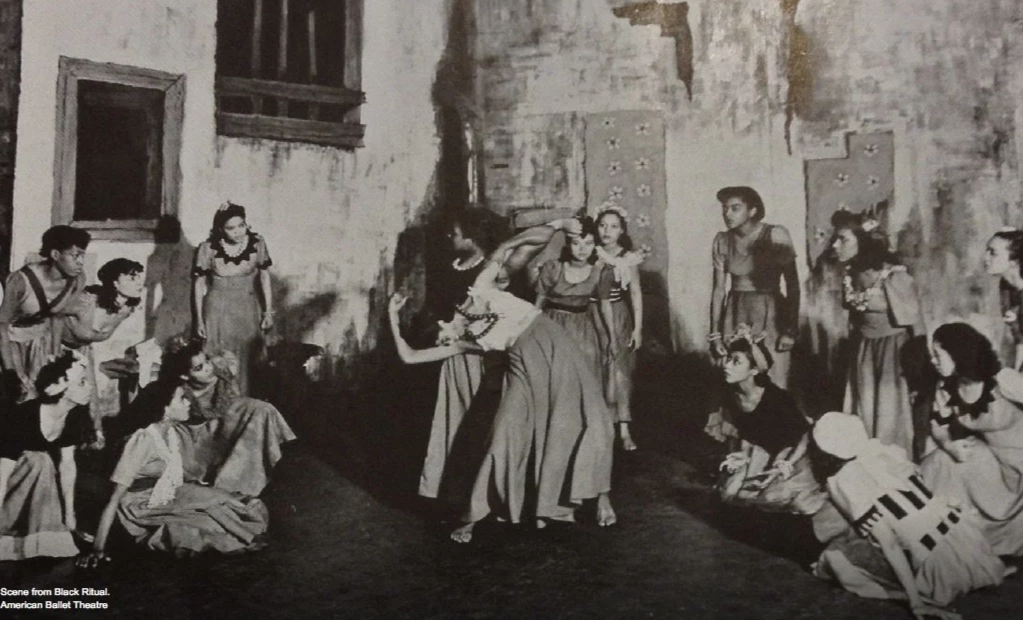
Agnes de Mille’s Black Ritual (Obeah) for Ballet Theatre, 1940.
Marvin:
Do you think the ritual can free Black people -in a spiritual sense?
Macbeth:
Yes, I think so. Not only free them, but it can clarify for Black people their ultimate strengths and powers.I believe that in the ritual there's a greater sense of power, of force, spiritual current. It is a releasing kind of experience. The same kind of force that 1s being exerted when something is really going down in those street churches when it really gets to going down you know that there's a' lot of things going on there but it's aimed at this white cat on these two pieces of wood-it's all aimed at him, it's all being controlled by an entirely different system of values. Now if we do the rituals, the Black rituals, that same force will be generated, but it will be generated toward a Black Releasing God, the God of our Blackness, the God of our conscious existence-
Marvin:
The God Of Freedom, Justice, and Equality!
Macbeth:
Right. It's simply something that I'm afraid—
Marvin:
You don't think the people are ready or it?
Macbeth:
I think we're preparing them piece by piece, Marvin. I think we'll do one by the end of the season. We'll close up in the winter time, we'll close up and go to Africa around December or January, stay three months, and study with the Brothers. I think at that point we can really begin to learn some things about the ritual, get some of the Brothers and Sisters to trust us enough to teach us some of the things. I'm serious about the magic and the mystical forces and the spirituality of human consciousness. And I think it goes beyond what the white man calls science, beyond what the man calls human endeavor, it goes very, very far beyond that. I think that we as a people can exert that kind of force. I think that together exerting that kind of force we are freed and the means of our freedom will be made clear to us. If we can get the people to do the rituals, at that point exactly what was true in the Battle of Algiers is again true. In the Battle of Algiers the people were together, they had performed the rituals, they had the common existence, they exerted a common thing.
Remember that great scene when they were all (Macbeth yells)? To be able to have all of Harlem do that some night-do you realize what force that would exert below Central Park? Below Central Park-the buildings would shake, they would shake! You see the people can only do that if they do the rituals. If we do the rituals, then they will understand to do those things. They will understand what signs to make. They make signs now-they make the crossing of themselvesA. few other people make a few other signs, but the real signs, the signs that have been in us for all these years that have continued in us all these years-we'll only know how to make when we begin to do the rituals again, when we begin to sing praises, Al Hamdu li-llah!
Marvin:
Right.
Macbeth:
Once the rituals are done again, then we will understand all that. All of those store front churches will change, they will become places of ritual, where the Black people will do their rituals. They'll no longer cheat with the white man on the wood-prophet though he might have been.
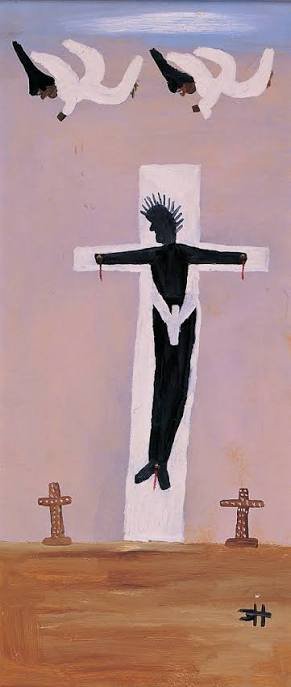
Courtesy of: Clementine Hunter ((1886 or 1887–1988), c. 1972
Marvin:
That white man wasn't no prophet.--
Macbeth:
So, the rituals must be done. We're hoping in Africa to learn some things about the ritual, learn how to do spells.
Marvin:
Brother, I hope there are some rituals in Africa that you can use to help liberate our people, but I'm just wondering if the new rituals aren't over here.
Macbeth:
They are, they are. See, wherever the rituals come from more of their vibrations still exist there. Now all I'm interested in is to become more intuned with the vibrations of the rituals so that as f come back-this is an environment in which-as I said to you before, I'm afraid to do the rituals-it's a difficult environment to do the rituals in, so I need strength, I need some more support in doing the rituals. So, to be able to say, yes, I saw the Brothers doing them, and know, it reassures me of the value of the rituals, and allows me to know that as we perform them they will be true, they will be real, as they should be. It's again a step away from any other kind of theatre that we would know know about. You see the difficulty even now as we talk about them is that I'm certain you understand what I'm saying to you, but I'm sure that nobody else would have the faintest notion of what we're talking about.
Marvin:
Well why don't you distinguish a play from a ritual.
Macbeth:
You know all the plays we've done so far, In The Wine Time, Who's Got His Own, and the play we're working on now, We Righteous Bombers, we approach from a ritual point of view. We always try to approach it from the point of view of a service, a ritual of some kind, and for that reason, because we approach them that way, our plays are a little bit different in a lot of things, the timing, time, the way the thing gets done, the way it's staged, how it staged, why it's staged that way; little differences. Who's Got His Own, a very formal ritual which includes the people. In The Wine Time did the same thing; it includes the people in there so they understand this thing is between us, among us all. Who's Got His Own, we were about to go even further with it than we did with Wine Time because as we walked into “The Room” our attempt was to get the audience to relate to the ritual we were going to perform, so the music, the tones, the way the play begins with the people coming into the theatre and setting themselves, coming and setting themselves, the beginning tones of the ritual. At that point we began to realize that what we were trying to do was to actually let everyone participate in it almost very much like-I was brought up in the western church, the Episcopalian and Methodist church, and I'm hipped to how that service was so-everyone dug that service, getting into that service, and what I felt wast hat it was important to get people into the service.
“If 40 million people cast a spell on you you’re in trouble, cause your will cannot resist those vibrations-if they’re honest and true, your will can’t resist them!”
Now plays as the westerners do them are shown to you, even if they're so-called audience participation play, they're still kind of shown to you. I'm not interested in that. And at that point we become different in perspective because the thing that we begin to do immediately includes all the people who come. So all of these things are orientated around, "Welcome, sit down Brother, we're gonna hold hands and sing, hum...." Now, we're still doing play-form rituals in that there are things discussed between characters, we still use characters, we still use fictitious circumstances of some kind, we still use the past or the present or the future somewhere else. Seldom is it right here and now, in here with us, you and me, seldom is it that; that's what the ritual says, "Good evening Brothers, good evening Sisters, we will now sit, hold hands and contemplate our togetherness with Allah.
At that point, if you can get the people to sit down and hold hands and contemplate their togetherness, you don't have to tell them too much more than that. The kind of vibrations that then happen-and it has happened some nights with the play-form rituals we've done. There have been those nights when you knew that the vibrations were so right that everyone in there was Black and together. And no one was saying that, it's just that you knew it, that they were together on the basis of vibrations, on the basis of experience. So what we would like to return to are those rituals that our people did in ancient times, rituals that taught the young men the essence of courage and manhood. Rituals that showed the young women their place in the history of their people. Those are plain, old, ordinary, educational ones.
Then there are the more mystic ones, the more spiritual ones, and those are the ones that call upon the ancient Black gods, and call upon the spirits of the fathers, and the spirit of the ancestors to be of importance in the present as we continue...At that point you recognize that your powers and your forces are far beyond individual egos, you know that we're only a continuation of a people who have existed for centuries, for thousands of years, and here we are together in this wilderness of North America, and we should sit and make sure we call upon the spirits. Once we're doing that, you know, like, to learn to cast spells, do curses, would be simple, because at that point-if 40 million people cast a spell on you you're in trouble! I don't care how bad you are-if 40 million people cast a spell on you you're in trouble, cause your will cannot resist those vibrations-if they're honest and true, your will can't resist them!
Macbeth:
We Righteous Bombers is an interesting ritual. It's one that tries to involve the people in a mental future, in the extension of certain kinds of ideas, but a very honest kind of view that doesn't make too many choices for the people but it tries to involve them in their possible future, and it gets them going with the environment and the sound; then it gets them involved in the concerns of that time and then as it goes along you realize that you're being encouraged to argue your points. People will be encouraged to try to relate to the play as if it were a real thing, to talk to it, to come and watch it often, like people used to do the Wine Time, to come and watch the ritual often to get to know it well, It'll be a play I guarantee will have a very, very high incidence of return.
People will return because they have to make sure they understood, make sure that they heard, because it deals on a very complicated level, so complicated in fact that it's often times very hard for us to even talk about it-it gets very, very far out there. But it's a ritual, or what we intend to do with it will be somewhat of a ritual. As I said, we're still using the western play-form as the basis. At some point we'll begin to do rituals which are pure.
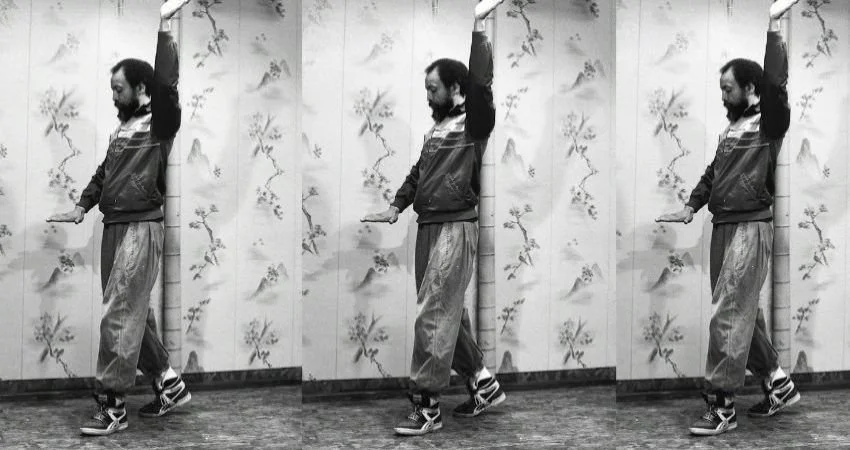
Still from Jake Meginsky and Neil Young’s Milford Graves: Full Mantis
Marvin:
In terms of myself, I'm just wondering what this is going to do to the playwright, but Brother Milford Graves was talking about revolutionary Black music; he was saying that if the Brothers are playing pure Black music they won't be able to make notations. In the same sense, 'm just wondering ii we'll be able to write out Black rituals.
Macbeth:
Well, I think what you'll be able to do is write out the skeleton. I don't think you'll be able to write out everything. I think you'll be able to write out the skeletons and then those who perform the ritual, as they do it, they will fill it up. And so it becomes a kind of communal thing. I think, yourself, in fooling with some of them, you'll see there are certain kinds of things you can lay out which then leave room for all kinds of things without even saying anything about it, with just giving certain kinds of tones, the colors, the colors involved, what words are chanted often, and how often. Now in between that all kinds of things can be done. The moment we seriously consider it and do it, then at that moment we have stepped away from mere theatre, mere western theatre, we've stepped away to cultivate the spirits again, at that point we begin to participate in the Resurrection!
I think we're preparing our people, the New Lafayette audience, for that step into participating in a ritual in which the spirits of the fathers are encouraged, in which spells are cast, in which new vibrations are created that never existed before. The rituals will break the barriers that language and a lot of other things, dress, clothes, education, a lot of those western things that we get entrapped by, that keep our people separated, one from another; they will break through those barriers. See, people who saw In The Wine Time could say, well, it was just street brothers, cussing and drinking. It was hard, the ritual was hard to understand because they got involved with the language, and it got very complex.
Marvin:
The language divided everybody!
Macbeth:
Yeah. You see the fact that one group of people didn't talk tike another group of people, or didn't relate like another group of people, they got into trouble about who was connected to who, who was whose Brother. So the language got in the way. Who's Got His Own had less of a problem. We Righteous Bombers will have a different kind of a language problem, but it will have a language problem too. And once we begin to do the rituals in which the language is the language f our people, then all of those other discrimination cease to exist: the fact that, wetI , this cat is a street cat, or this cat's got konked hair, or this cat is wearing alligator shoes, or this cat ain't got his dashiki on right, or this cat, he don't read Chairman Mao, or this cat it—all becomes irrelevant. Because the language becomes the language of our people, and that language has no distinctions.
Marvin:
So we actually won't be free until we change our language.
Macbeth:
Until we change our language, yeah. As we won't be free until we change our music, as we won't be tree until we change our theatre; until we begin to do the rituals again, when we start doing the rituals again and stop doing "plays".
Marvin:
That will be Black Theatre?
Macbeth:
That will be Black Theatre-Then we'll really be doing Black Theatre. But by then we'll all probably be hunted down and shot like dogs in the street. Because at that point cats won't be able to buy that-they will not allow 200 or 300 Black people, or even a 100 Black people a night, to come do rituals. That will be beyond the capacity of this system to deal with. In the Black Ritual Theatre there will be no disguise, no fooling, no body dressed up in any fake costumes and saying dialogue, and doing all those funny 'things. No, the people are seriously sitting down and getting it together, casting spells, and clarifying themselves as people. The rituals will save us. See, that was the first thing they took from us when they dragged us over here. They said, "No rituals! You do a ritual and I'll cut your throat! I'll cut off both your hands .... " No rituals, they wouldn't let the people do the rituals. Like the Haitians that's one of the reasons why they had their revolution-
Marvin:
Because they performed the rituals?
Macbeth:
Because they performed the rituals. I'm deadly serious about that, you read any historical study on it, and out of it Tourraint comes, and Mackandal. They performed the rituals, they still do-
Marvin:
What about some of the slave revolts over here?
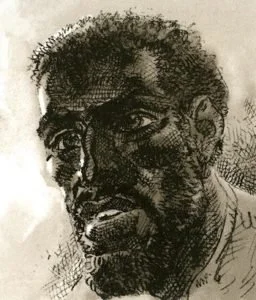
A drawing of Nat Turner
Macbeth:
The closest thing to that was Nat Turner's. And Nat had that Christian thing in the middle between him. He was very close, but he had. that Christian thing going. His mind had been hurt by that, and so a lot of the difficulty of his organizing and of his getting the thing together was because he was trying to do a Christian thing and that religion does not perform for us. It may perform, but it doesn't perform for us. A group of white people sitting around trying to do one of the rituals-that's ludicrous, stupid-they don't know what that is. So for us to sit round trying to do a Christian thing is silly also. And Vessey didn't have any ritual thing going with him. You do understand that the rituals are very serious and important things. And you do understand that I'm not just talking about marching up and down the aisle-that's not what I'm talking about.
I'm talking about a very deadly serious effort by whatever group of people are together to relate and to use their spiritual forces toward one kind of object, which is the togetherness, the nation, the nationhood, the Being, the realization, the recognition of Self!